
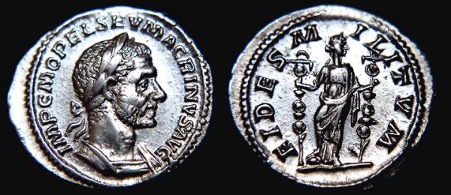
On the 8th April 217 AD the Severan emperor Caracalla was murdered by a member of his bodyguard in Syria whilst travelling between Edessa and Carrhae. In the days that followed the army hailed his praetorian prefect, Marcus Opellius Macrinus and his young son Diadumenianus, jointly to the purple. Herodian directly implicated Macrinus in the murder of Caracalla, claiming that he had intercepted a dispatch that would have resulted in his own death.
It was an incredible rise for a man from relatively humble beginnings, Macrinus was a Moor by birth (c.164 AD) from the region of Mauretania. This alone was not uncommon, Caracalla’s own father Septimius was a native of Lepcis Magna in North Africa. However, it was the first time someone from the equestrian class had been risen to become Caesar. This was not popular amongst the senatorial elite in Rome, Cassius Dio (a contemporary senator) compared his emperorship to an ass being led up to the palace.
Upon his ascension, Rome was in the midst of three separate conflicts: Dacia to the north and Armenia and Parthia to the East. During his time as emperor, Caracalla had spent lavishly upon building projects (the incredible bath complex in Rome) and on his campaigns. This left Macrinus with the coffers empty and in a struggle to maintain happiness amongst his troops- who had been very generously rewarded by Caracalla (he had increased pay by 50%).
Back in the Rome the situation was not much better where the Senatorial class were unimpressed with Macrinus’ elevation. Macrinus’ class must have played on his mind, as he desperately sought out patrician status for his son and the titles of princeps iuventutis and Caesar. One of the great errors Macrinus made during his reign were unpopular appointments. Despite knowing that one of the great prejudice’s against him, besides being a usurper, was his class he set about elevating other equestrians into positions of power. For instance, Marcus Agrippa, formerly a beautician, was raised to the governorship of Pannonia and then Dacia. These two were prestigious provinces which upset the senatorial elite immensely. However, Macrinus would have been well aware that Pannonia had been the governorship from where Septimius Severus had launched his legions to seize the throne.
For Macrinus, his ultimate downfall wasn’t the senate but the very troops who had elevated him. His troops suffered a humiliating skirmish with the Parthians at Nisibis in 217AD which culminated in a peace treaty that included paying reparations to Rome’s eastern rival. Deprived of booty and ruled over with firm discipline, the soldiery also caught wind of the lifestyle of excess the emperor was leading in Antioch.
So when in May 218 a young man by the name of Elagabalus presented himself as the illegitimate son of Caracalla (who had rewarded the troops so well), fortunes quickly swung in the pretender’s favour. Here again was an example of Macrinus underestimating the precariousness of his position. Upon his ascension he had been keen to associate himself with the Severans, allowing Julia Domna’s (Caracalla’s mother) sister Maesa and her family to live. However, in May 218 he found Maesa (according to Herodian) willing to ‘give all her money to the soldiers if they restored the empire to her family.’ On the 16th of May 218 her grandson Bassianus (Elagabalus) was proclaimed emperor at Emesa and shortly afterwards his troops defeated Macrinus near Antioch on the 8th June. Macrinus himself was caught and killed in Cappadocia shortly afterwards.
Macrinus’ reign was short and turbulent, but it marked an important turning point in Roman history- anyone, regardless of their social status, could become emperor. It signalled the beginning of the end of the position of ‘kingmaker’ that the Praetorian Guard had presided over for so long. Soon after his ascension, Elagabalus enacted damnatio memoriae upon Macrinus. This along with the prejudice of the senatorial accounts of his reign make for a complex analysis. He was certainly a capable administrator but ultimately Macrinus’ failure to attain legitimacy amongst the troops and senate would prove his downfall. His reign served as a precursor of events to come during the Crisis of the 3rd century- a period in which military anarchy almost caused the collapse of the Roman Empire.

 LazyHistorian Unknown
Leave a comment