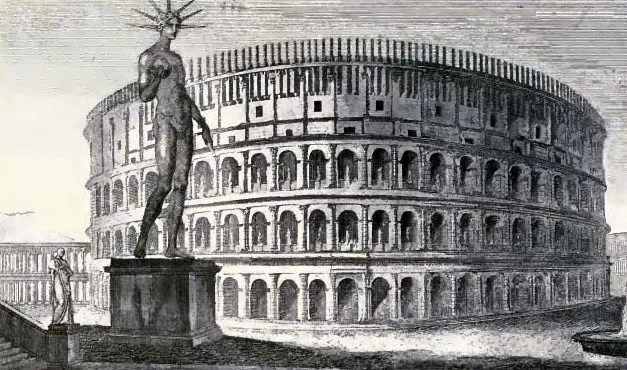
Where better to start our whirlwind adventure of the ancient world than with one of the most ‘colossal’ monuments. It was commissioned by the last Julio Claudian emperor, Nero, in 64 AD to be erected in the vestibule of his Domus Aurea (the notorious imperial villa complex that was built in the aftermath of the Great Fire of Rome) and spanned much of the Palatine Hill.
Completed four years later in 68 AD, the statue was designed by the Greek sculptor Zenodorus and was recorded by Pliny the Elders to have stood at an extraordinary 106.5 Roman feet (30.3 meters) in his Natural History. The bronze exterior would have sparkled in the Italian sunshine, but within it was hollow and supported by a framework of iron and wood. One of the tallest structures in the ancient world, Suetonius claimed that it was so tall a ship could sail through its legs. The Colossus served as a looming reminder of the emperor’s omnipotence in the heart of the Roman world.
Unfortunately for him, the emperor who commissioned the Colossus did not last much beyond the statues completion. In the year 68 AD the Roman aristocracy had tired of his cruelty and ineptitude. Forsaken by all except one slave, Nero committed suicide and brought to an end the line of Julio Claudian’s who had ruled Rome since Augustus. The Roman World fell into anarchy with four men ascending the throne in one year until only one, Vespasian, remained.

However, this was not the end for the Colossus. Although built in the image of the fallen emperor, Vespasian didn’t destroy the statue. He instead opted to rename it the ‘Colossus Solis’ after the Roman sun god and moved it to a new location. This was in the vicinity of another wonder of the ancient world, the Flavian Amphitheatre, or as it is more commonly referred as today (perhaps due to its association with the Colossus), the Colosseum.
The Colossus would watch emperors come and go for the next 300 years, a domineering feature of the ancient Roman skyline. It served as a reminder of the wealth and power of the Empire to which it belonged. Perhaps then, it was symbolic of the demise of Rome that it was destroyed sometime in the early 5th century AD. There is no definitive end to the Colossus, with vandalism, earthquakes and fire all having been suggested as causing the great statue to tumble. The bronze and any jewels that adorned it were then stolen.
An illustration of the autocratic, egotistical, matricidal maniac that was Nero? Yes. But nonetheless the Colossus was a wondrous marvel of the ancient world. It was an incredible feat of engineering that was symbolic of the awesome power and wealth of the Roman state in the 1st century AD. It is therefore perhaps fitting that the state and the statue would ultimately share the same fate.

 LazyHistorian Unknown
Leave a comment